Entities Table
The Entities table is the one place where every object in your tenant, of any type, is a row you can sort, filter, configure, select and act on. The Zscaler console shows you one policy family per screen with the columns it decided you needed. This table lets you decide.
It is the working surface for anyone doing inventory, cleanup, tagging or bulk changes.
When to use it
- Inventory and audit: list an entity type with exactly the columns the question needs.
- Tagging campaigns: select many entities and tag them in one gesture.
- Bulk changes: the selection you make here is what Mass Edit and policy reordering operate on.
- Turning findings into work: select the affected entities and create linked to-dos.
Where to find it in the UI
Hover the ZHERO icon, click Dashboards, and open the Entities tab. It carries a BETA badge and shows a count of the entities currently listed.

Pick an entity type from the selector, and the table loads that type.
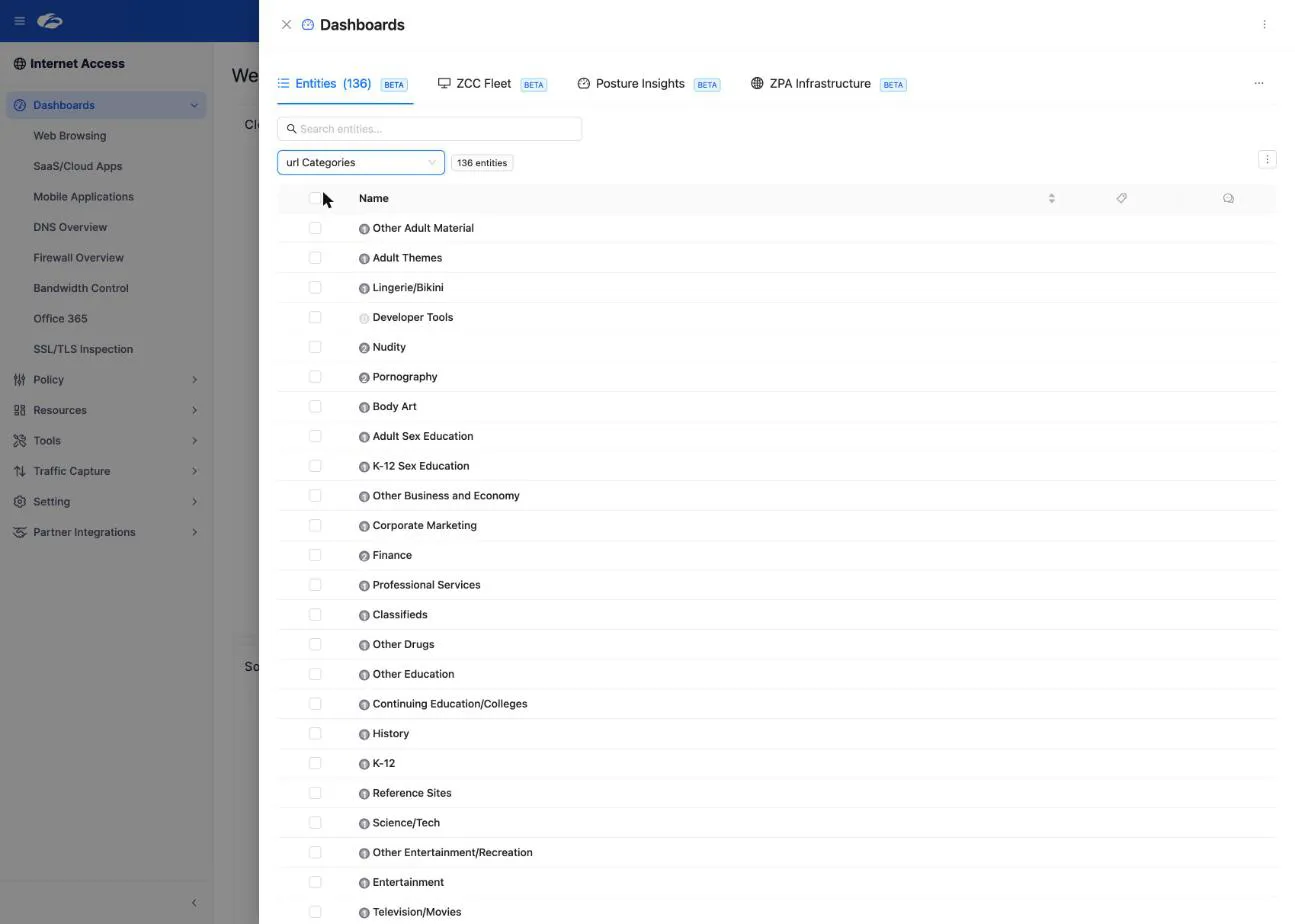
Configuring the columns
The three-dots menu at the top right of the table is the column menu. From there you can:
- Show or hide any column, applied immediately
- Reorder the visible columns
- Add curated relational columns on policy entities: the criteria fields the policy actually uses, such as users, groups, posture profiles, trusted networks, client types, platforms, locations, URL categories or application segments. Each cell renders the referenced entities as interactive items, capped at 15 with a “+N more” control
- Add fields from “Other fields”, an automatically derived section exposing the remaining attributes ZHERO holds for that entity type
- Reset to defaults for the current entity type
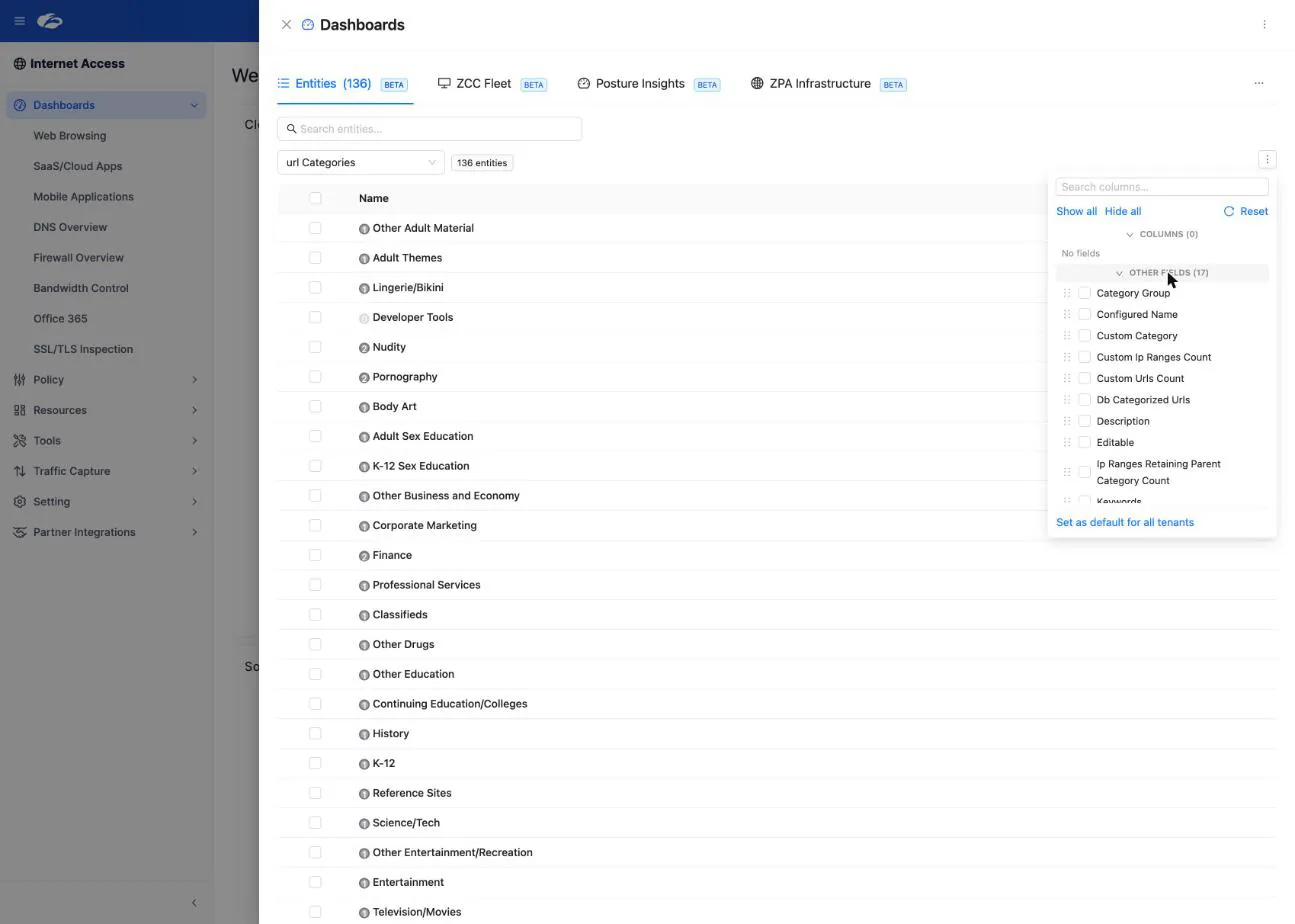
The arrangement is saved automatically, per entity type. Come back tomorrow, switch to that entity type, and the table is exactly as you left it. Each entity type keeps its own layout, so customising firewall rules does not disturb application segments.
This is the feature that turns “export it to Excel and pivot it” into “look at it”. A policy list with the posture criterion as a column answers a posture audit on screen.
Selecting and acting
Select rows with the checkboxes and a bulk action bar appears:
| Action | What it does |
|---|---|
| Assign Tag | Apply a collaboration tag to every selected entity |
| Unassign Tag | Remove a tag from the selection |
| Preferred | Mark tags as preferred, so they surface on entity cards and inline views |
| To-do actions | Create a new to-do for the selection, or link and unlink existing ones |
| Mass edit | Open the Mass Edit dialog for the selected entity type |
Bulk tagging and to-do actions need Collaboration enabled. Mass edit appears only for entity types that have editable fields, and only while reordering mode is off.
Reordering policies
On policy entity types, the table is also where rule order is changed: drag a rule to a new position, type a target position for precision, or select several rules and move them together. System and default rules are locked. See Policy Reordering for the full workflow.
What to watch
- The count next to the tab label is the number of entities currently listed, which reflects your filters. It is not necessarily the total in the tenant.
- Curated columns are relational. A cell listing 40 user groups tells you something about the policy before you open it.
- Selection survives your actions, not your filters. Mass edit captures the selection at the moment the dialog opens, so changing a filter behind the dialog does not silently change what you are editing.
Limits and notes
- The tab is labelled BETA.
- Relational cells cap at 15 items with a “+N more” expander, to keep rows readable.
- What you can see is what your Zscaler role can read. Entity types outside your permissions do not appear.
- Column layouts are saved per entity type, and a tenant-level override takes precedence over your global preference where one exists.
- Nothing in this table writes to the tenant directly. Every change goes through Pending Changes.
FAQ
Can I export what I see here? The export engine produces the Excel reports, with its own column selection and saved templates. The table is for working on screen; the exports are for handing data to someone else.
I added a column and it is empty for most rows. Curated relational columns only have content where the policy actually uses that criterion. An empty posture column across a policy family is itself the finding.
Why is Mass edit missing? Either the selected entity type has no editable fields, or reordering mode is active, or the capability is not enabled for your tenant.
Do my column choices affect my colleagues? No. The layout is yours.
Related pages
Next steps
- Open Dashboards, Entities, and pick the entity type you work with most
- Use the three-dots menu to build the view you always wished the console had
- Select a few rows and tag them, to see the bulk bar in action
- Come back tomorrow and confirm the layout is still there